Silverado ZR2 vs. Silverado Trail Boss: Off-Road Chevy Pickups Ranked by Capability
April 24 2026,
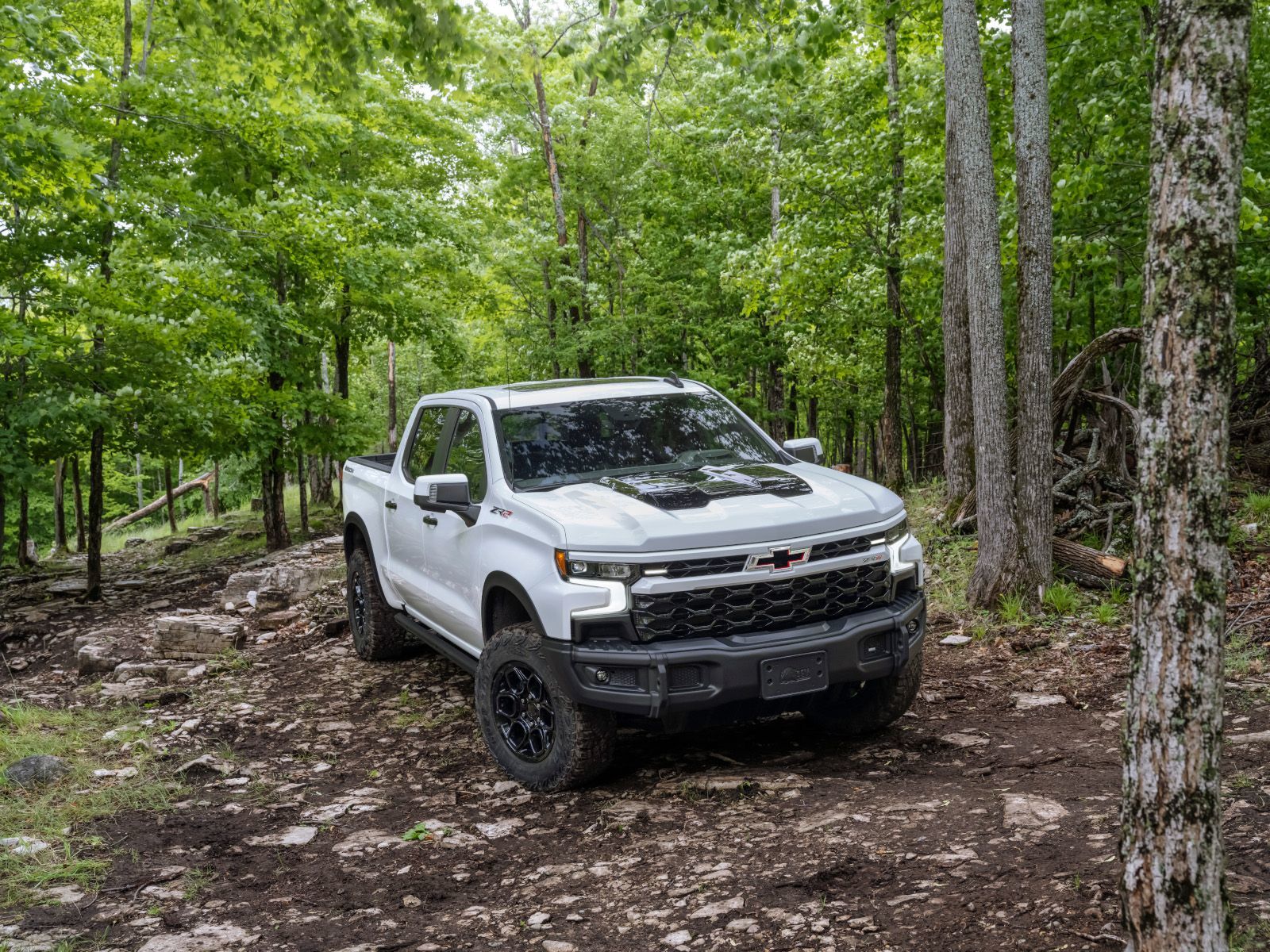
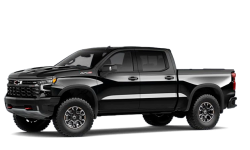
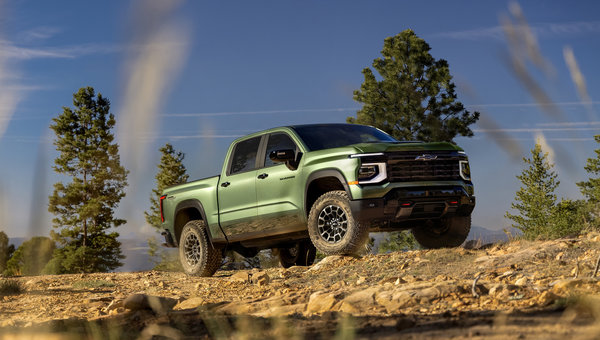
Both carry the Chevrolet badge. Both get lifted suspensions from the factory. Both roll on Goodyear Wrangler all-terrain tires. And both are specifically configured for terrain that would stop a standard pickup before the first hill. But the Silverado 1500 ZR2 and the Silverado 1500 Trail Boss are not interchangeable options — they're separated by hardware that matters the moment you leave the pavement.
This guide is for the buyer who's already decided they want an off-road-capable Chevrolet pickup, and now needs to know which one is actually built for what they're planning to do with it.
The suspension gap is the headline
The single biggest hardware difference between these two trucks is the damper technology.
The ZR2 comes standard with Multimatic DSSV dampers — a circuit-separation damping system that adjusts independently for compression and rebound. These dampers are the same technology used on purpose-built off-road race vehicles. They're not just heavier-duty shocks; they're a categorically different component class from the Trail Boss's Z71 suspension.
The Trail Boss, by comparison, runs the Z71 Off-Road Package with a 51-mm (2-inch) factory lift and standard shock tubing calibrated for the Z71 package. The lift, the Autotrac transfer case, and the Wrangler MT tires make the Trail Boss a genuinely capable off-road truck. They do not make it a ZR2.
Comparing the hardware side by side
|
Specification |
Silverado 1500 ZR2 |
LT Trail Boss |
|---|---|---|
|
Factory suspension lift |
51 mm (2 in) |
51 mm (2 in) |
|
Dampers |
Multimatic DSSV — standard |
Z71 standard shocks |
|
Ground clearance |
285 mm |
282 mm |
|
Front differential |
Electronic locking — standard |
No locking front diff |
|
Rear differential |
Electronic locking — standard |
Auto-locking |
|
Transfer case |
Autotrac 2-speed |
Autotrac 2-speed |
|
Approach angle |
33.5° |
— |
|
Underbody protection |
Large aluminum skid plates |
Z71 skid plates |
|
Standard tires |
33-inch Goodyear Wrangler Territory MT |
Goodyear Wrangler Territory MT |
|
Standard wheels |
18-inch ZR2-exclusive aluminum |
20-inch High Gloss Black |
|
Hill Descent Control |
Standard |
Standard (LT Trail Boss) |
|
Standard engine |
Duramax 3.0L Turbo-Diesel |
TurboMax 2.7L 4-cyl |
|
Available engines |
6.2L V8 |
5.3L V8, 6.2L V8, Duramax 3.0L |
|
Max towing (Duramax) |
6,033 kg (13,300 lbs) |
6,033 kg (13,300 lbs) |
|
ZR2 Bison Edition available |
Yes |
No |
The ZR2's three real advantages

- Electronic locking differentials — both axles
The ZR2 has a driver-selectable full locking front differential and a full locking rear differential as standard equipment. The Trail Boss has an auto-locking rear differential only — it reacts to wheel slip rather than allowing the driver to lock torque split proactively.
In practice, this means the ZR2 can maintain traction in deep ruts, off-camber trails, and sidehills where the Trail Boss's auto-locking system may not respond fast enough or aggressively enough to keep both axles moving.
- Multimatic DSSV dampers and a 33.5-degree approach angle
The ZR2's approach angle of 33.5 degrees is enabled by a front bumper cut specifically for off-road clearance. Combined with the DSSV dampers, the ZR2 can carry greater speed over rough terrain without the chassis-level impacts that would unsettle a standard suspension setup. The Trail Boss's approach angle is not published in the documentation.
- Larger underbody aluminium skid plates
The ZR2 runs large aluminium underbody skid plates that protect the drivetrain components more comprehensively than the Z71 package's skid plates on the Trail Boss.
The Trail Boss's real advantages
The Trail Boss makes two arguments the ZR2 can't:
Engine flexibility. The ZR2's powertrain menu is the Duramax 3.0L diesel (standard) and the 6.2L V8 (available). The Trail Boss offers TurboMax, 5.3L V8, 6.2L V8, and Duramax 3.0L diesel — four engine choices versus two. Buyers who want a 5.3L V8 in a factory-lifted truck with Wrangler MT tires have only one place to go.
Price positioning. The LT Trail Boss starts at a considerably lower price point than the ZR2. For buyers who want factory-lifted capability on a budget, the Trail Boss delivers the core off-road package — lift, Autotrac transfer case, auto-locking rear diff, skid plates, Wrangler MT tires — at a cost the ZR2 can't match.
Who should choose the ZR2?
The ZR2 is the right choice when the terrain you're planning genuinely demands both locking differentials, when the Multimatic DSSV suspension will change how the truck handles high-speed off-road driving, and when the documented 33.5-degree approach angle with the cut bumper is a functional requirement rather than a styling feature. The ZR2 Bison Edition adds AEV bumpers and boron steel skid plates for buyers who want the absolute maximum in underbody protection.
Who should choose the Trail Boss?
The Trail Boss is the right choice when the Z71 suspension lift, Autotrac transfer case, and auto-locking rear differential cover the terrain you actually use, when engine flexibility matters — particularly access to the 5.3L V8 — and when the ZR2's price premium is better directed elsewhere in a build.
Both trucks can tow up to 6,033 kg (13,300 lbs) when equipped with the Duramax 3.0L diesel, so towing capacity is not a differentiator between these two.
Drive both at Vision Chevrolet Buick GMC in Delson
The ZR2 and the Trail Boss are both in our lineup at Vision Chevrolet Buick GMC. Our team can put you in both trucks and talk through the specific terrain and use case you have in mind, so the comparison is grounded in what you're actually going to do with the vehicle rather than just spec sheets.